Ready to build your own Founder-Led Growth engine? Book a Strategy Call

Frontlines.io | Where B2B Founders Talk GTM.
Strategic Communications Advisory For Visionary Founders



Actionable
Takeaways
Embrace Iteration:
Regularly revisit and iterate on your marketing and product strategies based on customer feedback and market shifts. Flexibility can lead to significant growth opportunities.
Content-Driven Engagement:
Invest in creating and curating content that speaks directly to specific personas within your industry. Tailored content helps in building trust and converting leads.
Transition from SaaS to VaaS:
Consider the evolving needs of your customers. Sometimes, they may value outcomes over tools—leading to opportunities for delivering value as a service (VaaS) rather than just software.
Trust Your Team:
As a founder, it’s crucial to step back and let your experienced team members lead, especially in areas where they are experts. This trust can lead to better decision-making and growth.
Targeted Marketing for High Conversion:
Use data to identify and engage with niche segments within your market. Specificity in targeting can lead to higher conversion rates and deeper customer relationships.
Conversation
Highlights
From Software to Services: How Cove.tool Built the Future of Building Design
The sustainable building design space is undergoing a radical transformation, and Cove.tool, led by CEO Sandeep Ahuja, is at the center of it. In a recent episode of Category Visionaries, Sandeep shared how the company evolved from a traditional SaaS platform into what they call “value as a service” — a hybrid model that’s disrupting how buildings get designed across North America.
The Double Pivot Strategy
Most founders struggle with one major business model shift in their company’s lifetime. Sandeep has orchestrated two. First, Cove.tool transitioned from a consulting practice to a software company. Then, as AI capabilities matured and market demands shifted, they pivoted again — reintroducing services, but this time powered by AI and delivered at scale.
“We’ve actually made that switch twice now because we went from services to software, and then we’ve gone from software to software and services that are AI powered,” Sandeep explains. This evolution wasn’t arbitrary. It was driven by fundamental changes in how their customers wanted to consume solutions.
The first transition from consulting to software unlocked massive scale. “We learned that there was such beautiful harmony in being able to support not 100 projects a year, which is what we did as consultants, but 100,000 projects, which is what our software now is able to support.”
But something shifted as AI capabilities improved. Customers no longer wanted to learn software — they wanted results. “Folks no longer wanted software that they didn’t want to learn a thing and then do a study in it. They just wanted the study done,” Sandeep notes. “They were like, I go to ChatGPT, it doesn’t give me results. It just gives me the answer, can you do that, please?”
This insight led to what Sandeep calls “sassified services” — service delivery that operates with the scalability and go-to-market motion of traditional SaaS, but provides done-for-you outcomes instead of do-it-yourself software.
Dominant Market Position Through Deep Customer Understanding
Cove.tool’s current market penetration is striking: 70 of the top 100 architecture firms use their platform. When asked what they got right, Sandeep points to an unusually deep understanding of their buyer persona. “I know that no one can take that learning away from me, and I know that by listening to the folks.”
But market dominance also revealed limitations. The users who loved the software weren’t always the decision-makers who controlled project budgets. This realization drove the strategic shift toward services that appeal to firm leaders rather than just the practitioners using the tools.
The Land-and-Expand Playbook
Cove.tool’s go-to-market motion relies on a powerful land-and-expand strategy that lets customers start small and scale quickly. “You’ll do one or two or three projects with us and you’ll be like, oh my gosh, this is the best thing that ever happened because it’s lower cost, it’s faster, it’s better in every way, and then you come back for more,” Sandeep explains.
The economics are compelling: Cove.tool charges about a quarter of what traditional sustainability consultants charge and delivers in one week instead of four to six weeks. This value proposition resonates especially in the current market, where the architectural billing index has been down for four consecutive quarters.
Deals that start at $10,000 regularly expand beyond $100,000 within a year as customers experience the quality and efficiency gains. “The same deal that might have started out as 10k is over 100k by the end of the year, which is really wonderful and exciting,” Sandeep notes.
Content-Driven Community Engagement
Cove.tool’s marketing strategy centers on highly targeted content for micro-communities within the architecture, engineering, and construction space. Rather than broad-based campaigns, they segment aggressively and craft specific narratives for distinct personas and geographies.
Sandeep shares a concrete example: “Very recently we wanted to reach out to all of the architects that are specifically within California and not just all the architects, all of the principal architects. So that’s very specific persona, very specific geography.”
For this California campaign, they created a multi-touch strategy around recent energy code changes, deploying articles, webinars, and panels — all focused on that singular message. “We could drip kind of that campaign out and folks would get nurtured. Even if the first set of folks weren’t interested in a blog, perhaps they’re interested in a webinar.”
The approach requires extreme data sophistication. “We’re driving engagement across all of these micro communities within our AEC space. And I think that to do this really well, we’ve just needed to be extremely data driven almost to the contact level.”
Learning to Let Go
As a founder-CEO, Sandeep has had to master the art of delegation — what he calls “letting the chef cook.” It’s a skill he developed through mistakes and by watching the numbers closely.
When his marketing leader proposed dramatically reducing email volume — from hundreds of thousands to tens of thousands — Sandeep disagreed but let her execute the strategy anyway. “I was going to let the chef cook and I did. And I think it was really fun to watch our click through rates, our open rates, heck, our pipeline, all of that rise drastically.”
His philosophy is grounded in practical math: “If I’m spending the amount of money that I spend to bring on an excellent, incredible VP for any given department, what is the whole point if I don’t even collaborate with them, if they don’t even let them do their job?”
The Path Forward
Cove.tool isn’t stopping at sustainability consulting. Over the next three to five years, they plan to scale their AI-powered services playbook across all ten sub-verticals that surround architects — from mechanical engineering to structural consulting to civil engineering.
“I envision a world where Cove.tool is the de facto design professional that lowers the cost and design time across North America,” Sandeep declares. “So if you drive past any building that’s getting built, for you to know that was likely designed by Cove.tool, that is my vision.”
It’s an audacious goal, but one grounded in demonstrated execution. By combining deep domain expertise with AI capabilities and a willingness to reinvent their business model as markets evolve, Cove.tool has positioned itself to fundamentally reshape how buildings get designed. In an industry ripe for disruption, they’re not just participating in the transformation — they’re leading it.
Recommended Founder
Interviews


Marc Minor
CEO & Co-Founder of Higharc
Marc Minor, CEO & Co-Founder of Higharc: $80 Million Raised to Build the Home Building Cloud Category


Bryan Kester
CEO of SiteWire
Bryan Kester, CEO of SiteWire: $3.2 Million Raised to Transform Construction Finance


Anwar Ghauche
CEO and Founder of Constrafor
How Constrafor built indirect distribution to reach 75,000 companies: Selling to general contractors to access their subcontractors | Anwar Ghauche ($400M Raised)




Jack Sadler
CEO and Co-Founder of Part3
Jack Sadler, CEO & Co-Founder of Part3: $2.5 Million Raised to Build the Future of Construction Administration


James Gallagher
CEO & Co-Founder of GreenLite
How GreenLite discovered architects were the wrong ICP after 6 months of customer interviews | James Gallagher


Lindsay Powers
Senior Vice President of Marketing of STACK Construction Technologies
How STACK Built a Custom GPT to Close Content Gaps


Jack Oslan
Founder & Executive Chairman of Diamond Age
Jack Oslan, Founder & Executive Chairman of Diamond Age: $58 Million Raised to Build the Future of 3D Printed Homes


Nathan Silvernail
Co-Founder and CEO of Plantd
How Plantd identified business process inefficiencies as a competitive wedge in building materials | Nathan Silvernail


Tessa Lau
Founder & CEO of Dusty Robotics
Tessa Lau, Founder & CEO of Dusty Robotics: $69.5 Million Raised to Automate Construction Quality Through Robotics


Brian Giamo
CEO & Co-Founder of Activate OS
Brian Giamo, CEO & Co-Founder of Activate OS: Raising $4M+ to Build an Equipment Management Operating System for Construction

Ryan Fink
CEO & Co-Founder of Digs
Ryan Fink, CEO & Co-Founder of Digs: $14 Million Raised to Power the Future of AI Collaboration for Builders


Ari Bleemer
CEO and Co-Founder of OneCrew
How OneCrew resisted horizontal expansion to dominate one vertical in construction software | Ari Bleemer


Mark Zurada
Co-Founder of PinPoint Analytics
Mark Zurada, Co-Founder of PinPoint Analytics: $4 Million Raised to Transform Public Works Bidding with AI


Josh Levy
CEO & Co-Founder of Document Crunch
Josh Levy, CEO & Co-Founder of Document Crunch: $38 Million Raised to Transform Construction Risk Management Through AI


Stephanie Seril
Head of Marketing of Tough Leaf
CMO’s Guide to Saying No to Your Board and Keeping Your Job


Sherry Chapman
VP of Marketing of Fortera
Building Trust When Your Product Holds Up Buildings


Nitin Bhandari
CEO & Co-Founder of Planera
Nitin Bhandari, CEO & Co-Founder of Planera: $19 Million Raised to Transform Construction Scheduling Technology


Eric Helitzer
CEO & Founder of SubBase
Eric Helitzer, CEO & Founder of SubBase: $5 Million Raised to Innovate Construction Materials Management

Zach Scheel
CEO of Rhumbix
Zach Scheel, CEO of Rhumbix: $46 Million Raised to Transform Construction Workforce Management


Marco Herbst
CEO of Evercam
Marco Herbst, CEO of Evercam: €12.8 million Raised to Reimagine Construction Cameras


Wyatt Smith
CEO and Founder of UpSmith
Wyatt Smith, CEO and Founder of UpSmith: $3.3 Million Raised to Fill the Skilled Labor Gap

Luke Hansen
CEO and Founder of CompanyCam
Luke Hansen, CEO and Founder of CompanyCam: $38 Million Raised to Build the Future of Visual Communication for Contractors


Tom Yeshurun
Co-Founder & CEO of Civ Robotics
Why Civ Robotics trains construction engineers into sales reps instead of hiring salespeople | Tom Yeshurun


Chloe Smith
CEO and Co-Founder of Mercator AI
Chloe Smith, CEO & Co-Founder of Mercator AI: $4.5 Million Raised to Build the Future of Construction Tech


Brynne Hazzard
Director of Global Marketing of FYLD
The Bare-Bones ABM Strategy That Doubled FYLD’s Revenue

Nick Hegeman
CEO and Co-Founder of Paintjet
Nick Hegeman, CEO & Co-Founder of Paintjet: $17 Million Raised to Build the Future of Commercial Painting with Robotics


Nyasha Gutsa
CEO of Billy
Nyasha Gutsa, CEO of Billy: $4 Million Raised to Build the Future of Construction Insurance


Amar Amte
CEO & Founder of Pegbo
Amar Amte, CEO & Founder of Pegbo: $1.4 Million Raised to Transform Construction Supply Chain Diversity


Alexandre Teplitxky
Senior Vice President of Marketing of SmartPM Technologies
How to Win with Original Research Featuring SmartPM’s Alexandre Teplitxky


Shreesha Ramdas
CEO & Co-Founder of Lumber
Shreesha Ramdas, CEO & Co-Founder of Lumber: $21 Million Raised to Transform Construction Workforce Management

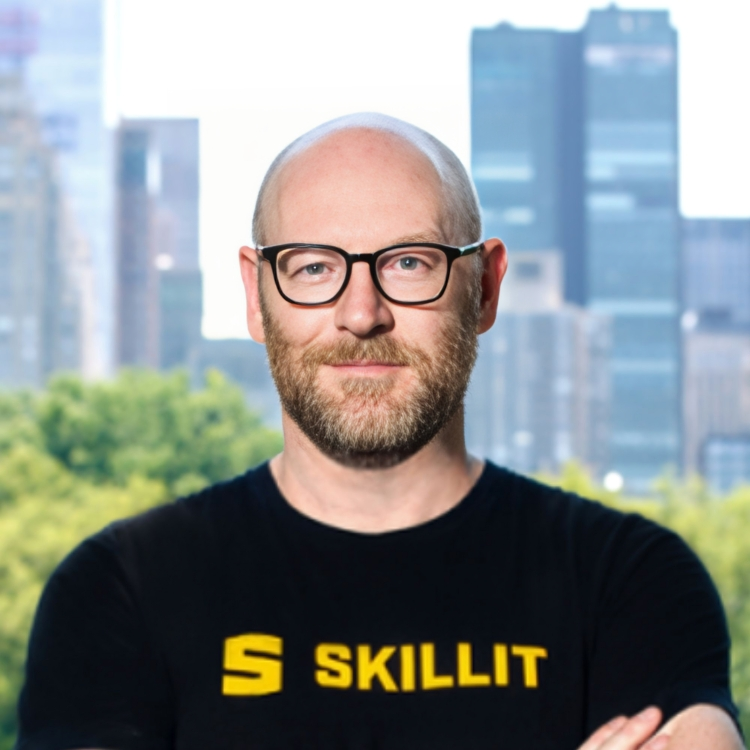
Fraser Patterson
CEO and Founder of Skillit
Fraser Patterson, CEO and Founder of Skillit: $13 Million Raised to Tackle the Skilled Labor Crisis in Construction